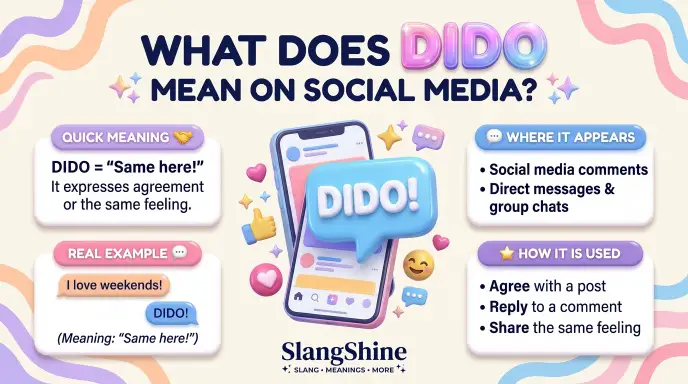
What does DIDO mean in text? DIDO is an informal way to say “ditto,” meaning “same here” or “I feel the same way.” People may use it in messages to show that they agree with someone or share the same feelings without repeating the entire statement.
For example, if a friend says, “I’m so tired today,” you might reply, “DIDO!” to show that you feel tired too. The more widely recognized spelling is ditto, although people may type DIDO as a variation or personal shorthand.
The exact meaning of What does DIDO mean in text depends on the conversation. Understanding the context helps you know if someone is agreeing with you, sharing your feelings, or using the term in another way.
What Does DIDO Mean in Text Messages?
In casual texting, DIDO may be used to express agreement or a shared feeling. It works like saying “me too,” “same here,” or “likewise.”
The word ditto is the established form. DIDO may appear as a misspelling, an informal variation, or a personal texting habit. Because DIDO is not a standard spelling of the word, it is best to consider the context before deciding what the sender intended.
Here are some situations where someone might use it:
- To show agreement:
A person may use DIDO to show that they share another person’s opinion. - To express the same feeling:
Someone might use it when a friend describes an emotion or experience they also have. - To avoid repeating a sentence:
A short response can communicate the same idea without writing a long explanation.
For example:
A: I can’t wait for the weekend!
B: DIDO!
In this conversation, B is likely trying to say that they feel the same way. The intended meaning is similar to “Me too!”
Remember that DIDO is less standard than ditto. If you want to avoid confusion, writing “same here” or “me too” is clearer.
What Does DIDO Stand For?
DIDO does not have a widely established full form as a texting acronym. In casual messages, it is often intended as a variation of ditto, rather than a phrase in which each letter represents a separate word.
The distinction matters because people sometimes assume that every short form is an acronym. However, some informal expressions are simply alternative spellings or typing mistakes.
Consider these examples:
- DIDO as an informal variation:
Someone may type DIDO when they intend to say ditto. - DIDO as a personal shorthand:
A person may use this spelling regularly in messages with friends. - DIDO in a different context:
The letters may refer to a name or specialized term outside casual texting.
If someone sends DIDO in a conversation about feelings or opinions, “same here” may be the intended meaning. However, the surrounding message is important because the letters can have other meanings in different settings.
How Is DIDO Used in Text Conversations?
People often use short replies when chatting with friends. A response such as “me too” can be quicker than repeating an entire sentence. When DIDO is intended to mean ditto, it serves a similar purpose. The following examples show how that usage may appear in casual conversations.
1. Showing the Same Feeling
A: I’m exhausted after work today.
B: DIDO!
Explanation: B is expressing the same feeling. A more standard reply would be “Ditto,” “Same here,” or “Me too.”
2. Agreeing With a Friend
A: That movie was amazing.
B: DIDO!
Explanation: B is likely agreeing with A’s opinion. The reply suggests that both people enjoyed the movie.
3. Sharing Excitement
A: I’m really excited about our trip!
B: DIDO! I can’t wait.
Explanation: B shares the same excitement. The extra sentence makes the meaning clearer.
4. Responding to a Compliment
A: You’re such a good friend.
B: Ditto! You’re always there for me too.
Explanation: Here, the standard spelling ditto communicates a similar sentiment. It shows that the positive feeling is mutual.
These examples illustrate the likely intended use when DIDO is being used as a variation of ditto. They do not mean that every message containing DIDO must have that meaning.
What Does DIDO Mean on Social Media?
On social media, people often use short expressions to react to comments, share opinions, and respond to friends. DIDO may appear when someone wants to express the same feeling as another person.
However, the spelling is not as widely established as ditto. Some users may understand the intended meaning immediately, while others may think it is a typo.
Here is how to interpret it on different platforms:
- TikTok: Someone may use DIDO in a comment to show that they relate to a creator’s statement.
- Instagram: A user might send it in a direct message to express agreement.
- Snapchat: Friends may use it as a quick response to a shared feeling.
- Discord: It may appear in casual conversations when people agree with another member.
- Reddit: A commenter might use the intended meaning to show that they share another person’s opinion.
The platform alone cannot confirm what the sender means. Read the full message to determine if the person is agreeing, sharing an emotion, or using the letters differently.
Is DIDO the Same as Ditto?
DIDO and ditto may be used with the same intended meaning, but they are not equally standard spellings.
Ditto is an established English word that means the same thing as something mentioned earlier. In conversation, it can express agreement or a shared feeling.
DIDO, on the other hand, is not the standard spelling of that word. When it appears in a casual message, the sender may have made a typing mistake or adopted an informal variation.
Here is a simple comparison:
| Expression | Meaning | Usage |
| Ditto | Same as what was said | Standard English word |
| DIDO | May be intended to mean ditto | Informal or nonstandard spelling |
| Me too | I share the same feeling | Clear, common expression |
| Same here | I feel or think the same | Natural in casual conversation |
| Likewise | The same applies to me | Slightly more formal in some contexts |
For example, if someone says, “I love this song,” you could reply with “Ditto,” “Me too,” or “Same here.” These responses are clearer than DIDO because their intended meanings are more widely recognized.
Is DIDO Flirty or Romantic?
DIDO is not inherently flirty or romantic. If someone uses it to mean ditto, the message usually expresses the same feeling or opinion as the other person. Its tone depends on the conversation.
When It May Sound Romantic
A: I really like spending time with you.
B: Ditto ❤️
Explanation: The heart emoji and the affectionate message make the exchange sound romantic. The word itself does not automatically carry a romantic meaning.
When It Is Just Friendly
A: I’m excited for the concert!
B: DIDO!
Explanation: Both people are excited about an event. There is no clear romantic meaning in this exchange.
When It Shows Agreement
A: We should definitely meet this weekend.
B: Same here!
Explanation: The reply shows agreement with a plan. It does not necessarily suggest romantic interest.
If you receive DIDO from someone you like, consider the whole conversation rather than judging the message by one word.
Is DIDO Rude or Offensive?
DIDO is not inherently rude or offensive when someone intends it as a variation of ditto. In that case, the person is usually trying to communicate agreement or a shared feeling.
However, the meaning may be unclear to someone who has never seen the spelling before. That confusion does not automatically make the message offensive.
Consider these points:
- The context: Read the statement the sender is responding to.
- The tone: Emojis and surrounding words may help clarify the intention.
- The spelling: The sender may simply have meant to type ditto.
- The relationship: Friends may understand each other’s informal writing habits more easily.
If you are unsure what the person means, ask a simple question. You can say, “Did you mean ditto?” This gives the sender a chance to clarify without making the conversation awkward.
How Should You Reply When Someone Says DIDO?
If someone sends DIDO and appears to mean ditto, you can respond naturally. Your reply should match the conversation rather than focus too much on the spelling.
Here are a few options:
- “Same here!”
Use this when you share the same feeling or opinion. - “Me too!”
This is a simple and widely understood response. - “Exactly!”
Choose this when you strongly agree with the other person’s statement. - “Haha, glad we’re on the same page.”
This works in a friendly conversation when you share an opinion. - “Did you mean ditto?”
Ask this if you are unsure what the sender intended.
For example:
A: I really need a vacation.
B: DIDO!
A: Same here. We both need a break!
The exchange remains natural because both people understand the shared feeling.
Common Mistakes When Understanding DIDO
A few common mistakes can make this expression more confusing than it needs to be.
- Assuming DIDO is a standard spelling: Ditto is the established English word. DIDO may be an informal variation or a typo.
- Treating it as a confirmed acronym: There is no single widely recognized full form for DIDO in ordinary texting.
- Assuming it is always romantic: The expression can simply show agreement or a shared feeling.
- Ignoring the surrounding message: The sentence before DIDO often provides the strongest clue to its intended meaning.
- Using it when clarity matters: Some readers may not recognize DIDO, so “me too” or “same here” is a safer choice.
Understanding these differences helps you interpret messages more accurately. When a spelling is unfamiliar, look at the context before deciding what it means.
Frequently Asked Questions About What does DIDO mean in text
Q1. What does DIDO mean in text?
Answer: DIDO may be used as an informal variation or misspelling of ditto, which means “same here” or “I feel the same way.” Its intended meaning depends on the conversation.
Q2. Is DIDO the correct spelling of ditto?
Answer: No. Ditto is the standard English spelling. DIDO may be a typo, a personal spelling choice, or an informal variation used in a message.
Q3. What does DIDO mean from a girl?
Answer: If a girl uses DIDO to mean ditto, she may be saying that she shares your feeling or opinion. The message alone does not prove romantic interest.
Q4. What does DIDO mean on Snapchat?
Answer: DIDO may be intended to mean “ditto,” or “same here,” in a Snapchat conversation. Check the message it responds to because the abbreviation does not have one guaranteed meaning.
Q5. Is DIDO flirty?
Answer: Not necessarily. It can express agreement or a shared feeling. The conversation, emojis, and relationship between the people help determine if the message is flirty.
Q6. What is the difference between DIDO and ditto?
Answer: Ditto is the established English word meaning “the same.” DIDO is a nonstandard spelling that may be intended to communicate the same idea.
Q7. How should I respond to DIDO?
Answer: You can reply with “Same here,” “Me too,” or “Exactly” if the context suggests agreement. If you are unsure, ask the sender what they mean.
Conclusion
What does DIDO mean in text? DIDO may mean “same here” or “I feel the same way” when someone uses it as a variation of ditto. However, ditto is the standard English spelling, while DIDO is nonstandard and may be a typo or personal shorthand.
When you see DIDO in a text message or social media comment, read the surrounding conversation before interpreting it. If you want to use a clearer expression yourself, choose “me too,” “same here,” or the standard word ditto.
Learn More About Slang:
- What Does DHZ Mean in Text? Slang or Just a Typo? (2026)
- What Does DI Mean in Text? Understand It in Seconds
- What Does Diddo Mean in Text? Did They Mean “Ditto”?

Hi, I’m Anna Whitmore. I have 7+ years of experience writing about English slang and vocabulary. At SlangShine, I create simple, easy-to-understand content for English learners.