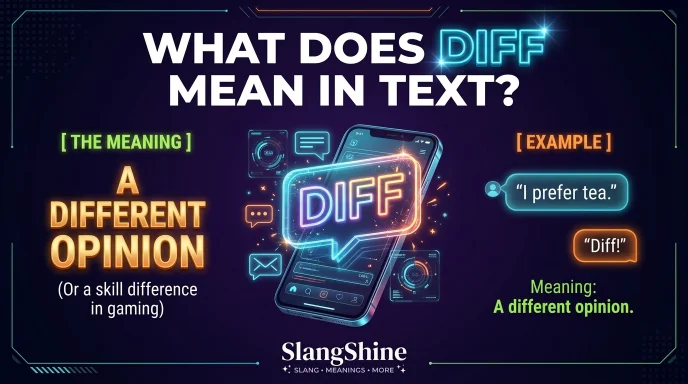
If you are wondering what does diff mean in text, it usually means “difference.” People use it in online chats, gaming conversations, social media comments, and everyday messages when comparing two things or pointing out how they are different.
The exact meaning depends on the conversation. If you’re wondering what does Diff mean in text, it usually means a difference between two things. For example, someone might say, “There’s a big diff between these outfits,” to highlight their differences.
The meaning of what does Diff mean in text can vary in gaming, programming, and online chats. Understanding the context helps you recognize how people use the term and respond naturally.
Diff Meaning in Text
In text messages, “diff” is a shortened form of “difference.” People use it when they want to compare two things, highlight a change, or explain that one thing is not the same as another.
For example, if someone texts, “I can see the diff,” they mean they can see the difference. Instead of typing the complete word, they use a shorter version that saves time.
Diff is not usually a formal acronym with a separate meaning for every letter. It is an abbreviation or shortened form of the word “difference.” In some situations, it can also refer to a difference file or a comparison between versions of a document or piece of code.
What Does Diff Mean in Everyday Chat?
In everyday conversations, people commonly use “diff” to describe a noticeable difference between two things.
For example:
- “There’s a huge diff between these phones.”
- “I noticed the diff in your new haircut.”
- “The diff is pretty obvious.”
- “This version has a few changes. Check the diff.”
Each sentence uses the word to talk about a difference, comparison, or change. The meaning can also be more specific. If someone says, “Skill diff,” they may be suggesting that one person has better skills than another. If they say, “Big diff,” they are emphasizing that the difference is significant.
Is Diff Slang or an Abbreviation?
Diff is best described as an abbreviation of “difference” that is also common in informal online language. It is not exclusively internet slang because the shortened word is also used in programming, document comparisons, and other technical settings. However, social media users and gamers have adopted it for casual conversations.
The distinction matters because the word does not always carry the same tone. In a friendly conversation, “diff” might simply describe a change. In a competitive gaming match, it might be used to criticize another player’s performance. Therefore, look at the surrounding words before deciding what the sender means.
Where Do People Use Diff?
People use “diff” across several messaging and social media platforms. The basic idea usually remains the same, but the context and tone can change.
Diff on TikTok
On TikTok, “diff” may appear in video comments, gaming clips, reaction videos, and discussions comparing people or things. For example, someone might comment, “The diff is wild,” under a video showing a dramatic transformation. They mean the difference between the two results is very noticeable.
Gaming related videos may use expressions such as “skill diff” or “team diff.” These phrases suggest that different levels of ability or team performance explain the outcome. The phrase can be playful, but it may also sound critical. Read the other comments and watch the video to understand if the person is joking or making a serious comparison.
Diff on Snapchat
On Snapchat, people may use “diff” in private messages when discussing changes, comparing pictures, or talking about two choices.
For example:
“Your old snap and this one have a diff.”
The sender is pointing out a difference between the two pictures. Friends might also use the word when discussing outfits, hairstyles, filters, or personal preferences. Because Snapchat conversations are often casual, a shortened word like “diff” fits naturally.
Diff on Instagram
Instagram users may write “diff” in comments, direct messages, Reels discussions, and gaming related posts. Imagine someone shares before and after pictures of a room makeover. A follower might comment, “What a diff!” to express surprise at the transformation.
In competitive or humorous posts, the word can have a sharper meaning. A comment such as “massive skill diff” may suggest that one person performed much better than another. However, “diff” does not have one special meaning exclusive to Instagram. The surrounding post and conversation determine its intended meaning.
Diff on WhatsApp
On WhatsApp, “diff” is useful for quick conversations with friends, classmates, family members, or coworkers.
For example:
A: Is this the new version of the file?
B: Yes, there are a few diff changes.
The second person is using “diff” informally to refer to differences between versions. A more natural alternative would be, “There are a few differences.”
Another example is:
A: Do these two pictures look the same?
B: No, I can see the diff.
Here, the sender means that the pictures are different. In everyday WhatsApp chats, the word is generally easy to understand when the people involved are already discussing two things.
Diff in SMS Text Messages
In regular SMS messages, “diff” can be used just as it is in other messaging apps.
For example:
“Is there any diff between the two plans?”
The sender is asking if the plans are different. It may also appear in messages about prices, schedules, products, schoolwork, or changes to an earlier decision. Unlike some texting abbreviations, “diff” does not require the reader to learn a complicated new definition. Knowing the word “difference” is usually enough to understand it.
10 Real Chat Examples of Diff
The easiest way to understand an informal word is to see how people use it in realistic conversations. These examples show several common situations, from everyday comparisons to online gaming.
Example 1: Comparing Two Phones
A: Is the new phone really better than the old one?
B: Yeah, there is a big diff in the camera quality.
A: Is it worth upgrading?
B: If you take lots of pictures, definitely.
Meaning: The speaker is saying that the camera quality is noticeably different.
Example 2: Talking About Clothes
A: Which outfit looks better?
B: The black one.
A: Why that one?
B: The color makes a diff.
Meaning: The speaker means that the color makes a difference to the overall appearance.
Example 3: Discussing a Hairstyle
A: Did you notice my new haircut?
B: Of course! There is a huge diff.
A: Better or worse?
B: Better, honestly. It suits you.
Meaning: The word refers to the visible difference between the old and new hairstyles.
Example 4: Comparing School Notes
A: Are your notes the same as mine?
B: Almost, but there is a diff in the last section.
A: Can you send me a picture?
B: Sure, give me a minute.
Meaning: The two sets of notes contain a difference in one section.
Example 5: Talking About a Game
A: How did your team lose that match?
B: Their player was much better than ours.
A: So, skill diff?
B: Pretty much.
Meaning: “Skill diff” suggests that a difference in player ability influenced the result.
Example 6: Comparing Two Pictures
A: Do you like the edited photo?
B: Yes, the diff is obvious.
A: Is the lighting better?
B: Yeah, and the colors look brighter too.
Meaning: The speaker can clearly see the changes made to the picture.
Example 7: Discussing Prices
A: This store sells the same headphones for less.
B: What’s the diff between the two offers?
A: The cheaper one doesn’t include the extra case.
B: Oh, that makes sense.
Meaning: The sender is asking what is different about the two offers.
Example 8: Comparing Old and New Work
A: I updated the presentation.
B: What changed?
A: Mostly the layout and a few slides.
B: Send me the diff when you can.
Meaning: The sender wants to see the changes between the earlier and updated versions.
Example 9: Friendly Teasing
A: I finally learned how to play this game.
B: Look at you! Noob to pro, what a diff.
A: Haha, I’m still learning.
B: Keep going!
Meaning: The speaker is joking about the difference between the person’s earlier and current performance.
Example 10: Making a Decision
A: Should we choose the first plan or the second?
B: What’s the diff in price?
A: Only five dollars a month.
B: Then let’s compare the features too.
Meaning: The speaker wants to know how the two plans differ in cost.
These examples show that “diff” can describe a change, a comparison, or a difference in ability. The surrounding conversation provides the clearest clue.
How to Reply When Someone Says Diff
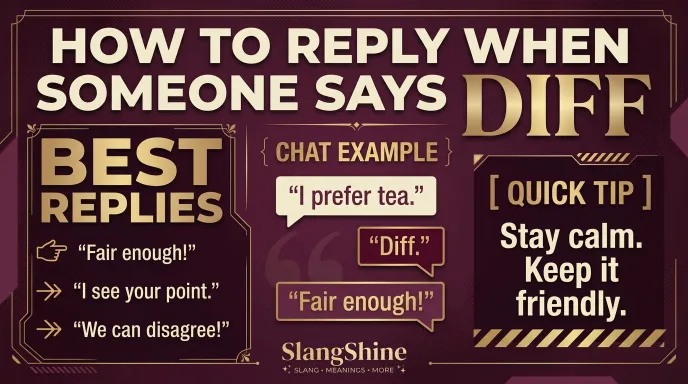
Your reply should depend on what the other person means. Sometimes they are asking you to compare two things. In other situations, they are making a joke or commenting on someone’s performance.
Casual Replies
Use these responses when the conversation is relaxed:
- “Yeah, I noticed it too.”
- “True, there is a difference.”
- “I can see what you mean.”
- “That’s what I was thinking.”
- “Exactly, they’re not the same.”
These replies work well when someone points out a difference between pictures, products, outfits, or other everyday things.
Funny Replies
If a friend uses “diff” while teasing you or discussing a game, you can answer with humor.
- “Huge diff, I’m basically a professional now.”
- “Skill diff? More like luck diff!”
- “The only diff is that I’m hungry.”
- “Give me a rematch and we’ll see.”
- “Massive diff, according to my biggest fan.”
Use these replies with people who understand your sense of humor. In competitive conversations, a playful response can keep the discussion friendly instead of turning it into an argument.
Friendly Replies
If someone is discussing a personal change or complimenting your progress, you might say:
- “Thanks for noticing!”
- “I’m glad you can see the improvement.”
- “Yeah, I’ve been working on it.”
- “I appreciate that.”
- “I’m happy with the result too.”
These responses are useful when “diff” refers to an improvement in your appearance, work, or skills.
Neutral Replies
If you are unsure what the sender means, a simple question can prevent confusion.
- “What difference do you mean?”
- “Can you explain a little more?”
- “Which part is different?”
- “Do you mean the price or the features?”
- “Are you talking about the updated version?”
The best reply is the one that addresses the actual conversation. You do not need to use more slang just because the other person did.
Is Diff Rude or Offensive?
The word “diff” is not inherently rude or offensive. It is a common shortened form of “difference,” and its meaning is generally neutral.
However, its tone can change depending on how someone uses it.
When Diff Is Harmless
In everyday messages, “diff” usually describes a comparison without insulting anyone.
For example:
“There is a diff between the two designs.”
This statement simply points out that the designs are not identical. Likewise, asking “What’s the diff?” is normally a straightforward way to ask how two things differ.
When Diff Can Sound Insulting
In gaming and competitive online discussions, expressions such as “skill diff” or “team diff” can be used to criticize another player or team. For example, someone might write “Huge diff” after a match to suggest that one team was much stronger than the other.
Depending on the situation, this can be harmless teasing or an attempt to embarrass someone. The word itself is not the problem. The comparison, tone, and intention determine if the message feels disrespectful.
Is Diff Appropriate at School or Work?
It is generally fine to use “diff” in informal chats with classmates, friends, or teammates. However, use “difference” in formal writing, school assignments, professional emails, and important workplace documents unless “diff” is an established technical term in your field.
For example, write “The difference between the two results is significant” in a formal report rather than “The diff is huge.” In programming, technical documentation, and version control discussions, “diff” may be the standard term, so using it can be completely appropriate.
Who Uses This Term?
“Diff” is not limited to one age group or online community. Its use depends more on the topic and the people involved than on age alone.
Is Diff Common Among Gen Z?
Gen Z users may use “diff” in gaming chats, social media comments, and informal messages. Shortened words are convenient in quick online conversations, especially when people already understand the context.
Still, it would be inaccurate to say that only Gen Z uses it. Older internet users, developers, gamers, students, and professionals may use the same word.
Do Gamers Use Diff More Often?
Gaming is one of the contexts where “diff” has a particularly recognizable meaning. Players may use it to discuss differences in skill, performance, strategy, or team strength.
For example, “support diff” may suggest that one team’s support player performed better than the opposing team’s player. These expressions can become shorthand within a community because players repeatedly discuss similar situations.
How Often Does Diff Appear Online?
There is no single reliable frequency that applies to every platform or audience. The word may appear frequently in gaming discussions and technical communities but less often in unrelated everyday conversations. Its visibility also depends on current trends, the platform, and the subject being discussed.
Rather than assuming that every user understands the term, consider the audience. If a conversation includes people who may not know gaming or internet slang, writing “difference” can make your meaning clearer.
Origin of the Term Diff
The word “diff” did not originate exclusively on social media. It is a shortened form of “difference” and has long been used in technical contexts to describe comparisons between files or versions of information.
Diff in Computing and Programming
In computing, a diff shows the differences between two files or versions of a file. It can help developers identify added, removed, or changed lines of text or code. For example, a programmer might compare an older version of a program with a newer one to see exactly what changed. In this context, “diff” has a specific technical purpose rather than simply acting as casual slang.
How Internet Culture Influenced Diff
Online gaming and social media helped make the shortened word familiar to wider audiences. Competitive players often need quick ways to describe why one team won or why a player performed better. Expressions such as “skill diff” turn the idea of a difference into a short judgment about performance.
Similar phrases can be used jokingly, critically, or sarcastically. As online communities interact, expressions from one setting can spread to others. A word that once appeared mainly in technical conversations may also become familiar in gaming discussions and everyday chats.
Is the Exact Origin Known?
The word itself is clearly connected to “difference,” but there is no need to assign one precise date, platform, or person as the origin of every online use. Its technical use and its informal use developed in different contexts.
The exact point when particular gaming expressions became popular can vary by community. The most useful thing to remember is that “diff” is an established shortening of “difference,” while phrases such as “skill diff” have more specialized meanings in certain online communities.
Diff vs. IDK, IDC, IMO, and BRB
Not every short word or abbreviation used online serves the same purpose. “Diff” refers to a difference, while the other expressions in this comparison communicate opinions, feelings, or actions.
| Term | Meaning | Type | Usage | Popularity |
| Diff | Difference | Shortened word | Comparing things, changes, or performance | Common in technical and gaming contexts |
| IDK | I don’t know | Initialism | Expressing uncertainty or lack of knowledge | Widely recognized in texting |
| IDC | I don’t care | Initialism | Expressing indifference | Common in informal chats |
| IMO | In my opinion | Initialism | Introducing a personal view | Common in online discussions |
| BRB | Be right back | Initialism | Saying you will return shortly | Widely recognized in messaging |
The popularity descriptions are general observations, not measured rankings.
How Are These Terms Different?
The main distinction is what each term communicates.
If someone says “IDK,” they do not know the answer. If they write “IDC,” they are expressing that something does not matter to them. “IMO” introduces a personal opinion, and “BRB” tells someone that the sender will return shortly. By contrast, “diff” usually refers to a difference between things or people.
For example:
- “IDK which one is better.” means the person is unsure.
- “IDC which one we choose.” means the choice does not matter to them.
- “IMO, the second one is better.” expresses an opinion.
- “BRB, I’ll check.” means the person will return shortly.
- “There’s a big diff between them.” points out a difference.
Understanding what each abbreviation does makes online conversations easier to follow.
Real World Usage Example
Imagine you and a friend are shopping for a new pair of headphones. You find two models that look almost identical, but one costs more than the other.
Your friend sends you a message:
“What’s the diff between these two?”
You check the product details and notice that the more expensive model has better noise cancellation and longer battery life.
You reply:
“The main diff is the battery life and noise cancellation. The cheaper one has fewer features.” In this situation, your friend is using “diff” as a shortened form of “difference.” If you’re wondering what does Diff mean in text, this example shows how it is used to compare two products. There is no hidden meaning, insult, or special social media reference.
Now imagine a different situation. You are playing an online game, and your team loses because the opposing team’s players perform better. One of your teammates writes, “Skill diff.”
This time, the expression refers to the difference in player ability that may have contributed to the result. Both examples use the same word, but the context changes how specific the meaning becomes.
When you encounter “diff” in a message, ask yourself what the people are discussing. If they are comparing products, pictures, or versions, the word probably means “difference.” If they are talking about a competitive match, it may refer to differences in skill or performance.
Frequently Asked Questions About what does Diff mean in text
What Does Diff Mean in Text Messages?
“Diff” usually means “difference.” People use it when comparing two things, describing a change, or pointing out that something is not the same.
What Does Diff Mean on TikTok?
On TikTok, “diff” can refer to a difference between things or people. In gaming videos and comments, phrases such as “skill diff” often suggest a difference in player ability or performance.
Is Diff Slang?
“Diff” is a shortened form of “difference.” It is common in informal online language, but it is also used as a technical term in computing and file comparisons.
Is Diff Rude or Offensive?
No, “diff” is not inherently rude or offensive. However, phrases such as “skill diff” can sound mocking or critical when used to put another person down.
How Should You Reply to Diff?
Respond according to the conversation. You could say “Yeah, I noticed the difference,” “What difference do you mean?” or, in a playful gaming chat, “Give me a rematch and we’ll see.”
Conclusion
“Diff” usually means “difference” in text messages and online conversations. If you’re wondering what does Diff mean in text, it refers to comparing things, describing changes, or pointing out differences in appearance, quality, price, or performance.
On TikTok, Instagram, Snapchat, WhatsApp, and other platforms, the meaning depends on the conversation. For example, “skill diff” in gaming refers to a difference in players’ abilities or performance. Understanding what does Diff mean in text can help you interpret these expressions correctly. In computing, “diff” can also describe differences between files or versions of information.
The term is generally harmless in casual conversations, although it can sound insulting when used to mock someone’s performance. For formal writing, “difference” is usually the clearer choice unless you are discussing a technical diff. Once you understand the context, recognizing and responding to “diff” becomes simple.
Learn More About Slang:
- What Does DIDO Mean in Text? Meaning and Examples
- What Does DI Mean in Text? Understand It in Seconds
- What Does Diddo Mean in Text? Did They Mean “Ditto”?

Hi, I’m Anna Whitmore. I have 7+ years of experience writing about English slang and vocabulary. At SlangShine, I create simple, easy-to-understand content for English learners.