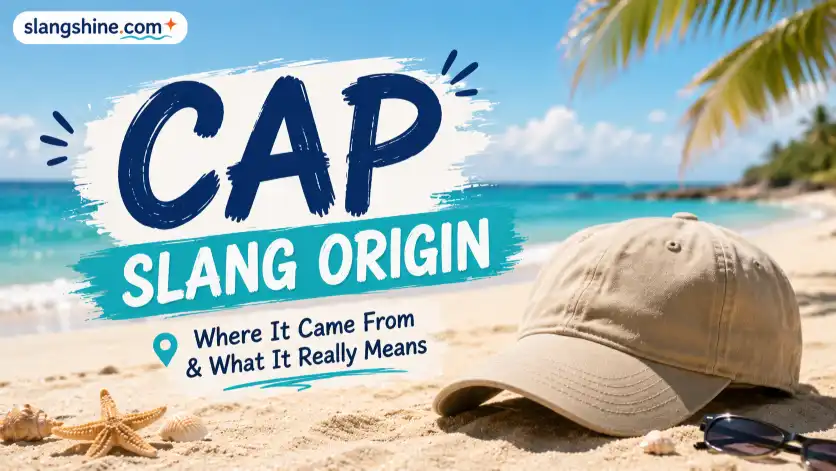
Cap slang origin is more interesting than it may seem. Today, people often use cap online to say that someone is lying, exaggerating, or not telling the truth.
You may see it in texts, TikTok comments, Instagram posts, gaming chats, and everyday conversations.
The slang also appears in phrases such as “no cap,” “that’s cap,” and “stop capping.” While these expressions are strongly associated with modern internet culture, cap did not begin with TikTok or Gen Z.
Its slang history is connected with African American Vernacular English (AAVE) and Black American cultural usage, before becoming much more widely recognized through hip-hop and online culture.
Understanding the origin of cap slang helps explain why the word can mean something very different from its ordinary dictionary meanings, such as a hat or a limit.
The modern slang meaning developed through informal speech and cultural use before social media helped take it to a much larger audience.
Quick Answer: Cap Slang Origin
The slang use of “cap” meaning a lie, false claim, or exaggeration is strongly associated with African American Vernacular English and Black American culture. The exact first use is difficult to establish, but the expression became more widely known through hip-hop and later through social media and internet culture.
What Does “Cap” Mean in Slang?
In modern slang, cap means a lie, exaggeration, or false statement.
If someone says:
“That’s cap.”
They usually mean:
“That’s not true.”
Similarly:
“You’re capping.”
Means:
“You’re lying or exaggerating.”
The opposite expression is “no cap,” which means “I’m being honest” or “I’m not exaggerating.”
For example:
“This is the best burger I’ve ever had, no cap.”
The speaker is emphasizing that they genuinely mean what they said.
The slang meaning is different from the ordinary meaning of cap. In standard English, a cap can be something worn on the head or something that limits an amount.
Cap Can Mean More Than an Outright Lie
One useful detail is that cap does not always mean someone is deliberately telling a serious lie.
Depending on the situation, it can also suggest that someone is:
- Exaggerating a story
- Boasting about something
- Making an unbelievable claim
- Stretching the truth
- Saying something the listener does not believe
So when someone says “That’s cap,” they may simply be challenging a claim rather than accusing the other person of serious dishonesty. This is one reason tone and context matter when interpreting the expression.
What Does “Cap” Stand For?
“Cap” does not have an official acronym-style full form. In modern slang, it is used as a word rather than an abbreviation.
When someone says “that’s cap,” they usually mean that something is a lie, untrue, exaggerated, or not believable. For example:
“He said he met a famous actor, but that’s cap.”
Here, the speaker means that they do not believe the claim.
The related phrase “no cap” means “I’m telling the truth” or “I’m not exaggerating.”
“That was the best concert ever, no cap.”
In this sentence, the speaker is emphasizing that they genuinely mean what they said.
So, if you are searching for the “cap slang full form,” there is no standard expansion such as “C-A-P” representing three words. It is better understood as a slang word with its own meaning.
Where Did “Cap” Slang Originate?
The modern slang meaning of cap is strongly associated with African American Vernacular English (AAVE) and Black American speech communities.
The word became especially visible through Black American music and hip-hop culture, where cap and related expressions were used in connection with boasting, exaggeration, and claims that were not genuine.
Later, the meaning became more broadly understood as lying or exaggerating.
It is important not to claim that one specific person invented the slang. There is no single confirmed inventor of “cap” in this sense.
Slang usually develops gradually. Speakers introduce expressions, communities adapt them, artists help spread them, and eventually wider audiences begin using them.
That is what happened with cap. Its modern meaning existed before today’s social-media platforms, while the internet helped make it familiar to a much larger audience.
Why Does “Cap” Mean “Lie”?
The exact linguistic explanation is not completely settled.
One commonly discussed explanation connects cap with earlier Black American slang involving boasting, exaggeration, or “talking big.”
Over time, the expression came to be used more broadly for claims that were false or exaggerated. Sources discussing the term also note that its precise origin is uncertain.
Because slang often develops through spoken communities rather than formal written records, its precise first use can be difficult to establish.
This is why it is better to say that the modern meaning developed through African American English and Black American cultural usage rather than claiming there was one exact moment when the word changed meaning.
Cap Slang Origin and Hip-Hop Culture
Hip-hop played an important role in helping cap reach audiences beyond the communities where it was already used.
Music can spread slang because listeners repeat memorable words and phrases in everyday conversation.
As hip-hop became increasingly influential across the United States and internationally, expressions connected with Black American speech also became familiar to wider audiences.
Cap and no cap eventually appeared in lyrics, interviews, social media posts, memes, and everyday conversations.
However, hip-hop should not automatically be described as the sole inventor of the term. It helped increase the word’s visibility and contributed to its wider cultural reach.
Gabb, for example, connects the term with AAVE, hip-hop, and street culture and describes its earlier association with boasting and exaggeration.
This distinction matters when discussing slang history. A word can become famous through music without actually originating in the music industry.
When Did “No Cap” Become Popular?
“No cap” became especially widespread during the 2010s and continued growing through the late 2010s and early 2020s.
Social media platforms helped accelerate that process.
People began using no cap to emphasize honesty in situations such as:
“No cap, that was the funniest movie I’ve seen.”
“I’m serious, no cap.”
The expression became easy to recognize because it is short, memorable, and useful in casual conversation.
Platforms such as Twitter/X, Instagram, TikTok, YouTube, Discord, and messaging apps helped spread the phrase to people who might not have encountered it in earlier forms.
By the 2020s, no cap had become familiar far beyond its original cultural setting.
Did TikTok Invent “Cap”?
No. TikTok did not invent cap slang.
TikTok helped make the expression highly visible, particularly among younger internet users, but the slang meaning existed before TikTok became popular.
This is an important distinction when discussing cap slang origin.
Internet platforms often make older slang appear new because millions of people encounter the term at the same time. A word can suddenly trend on TikTok even though it has been used for years.
The same thing happened with cap. Social media accelerated its mainstream popularity rather than creating the original slang meaning. Sources likewise describe the term as predating its widespread social-media use.
How Did “Cap” Become Mainstream?
The spread of cap can be understood as a series of stages:
- Community usage: The slang developed and circulated within Black American speech and cultural communities.
- Music and popular culture: Hip-hop and related media exposed the term to larger audiences.
- Internet culture: Online communities adopted and repeated the expression.
- Social media: Platforms made the slang visible to millions of users.
- Mainstream usage: People outside its original communities began using cap and no cap in everyday informal conversation.
This kind of linguistic spread is common. Slang often moves from specific communities into broader popular culture through music, entertainment, and social media.
What Does “No Cap” Mean?
“No cap” means “no lie,” “for real,” or “I’m telling the truth.”
It is often added to the end or beginning of a statement to emphasize sincerity.
For example:
“That was the best concert ever, no cap.”
Meaning:
“That really was the best concert ever. I’m not exaggerating.”
Another example:
“No cap, I studied all night.”
Here, the speaker is emphasizing that the statement is genuine.
The phrase is usually casual and conversational, so it is more natural in texts, social media, and conversations with friends than in formal writing.
What Does “That’s Cap” Mean?
“That’s cap” means “that’s not true,” “that’s a lie,” or “you’re exaggerating.” It is one of the most common ways people use cap in a sentence.
For example:
“I finished the whole project in ten minutes.”
“That’s cap.”
The second person is saying they do not believe the claim.
Another example:
“He says he never plays video games.”
“That’s cap. I saw him online last night.”
Here, that’s cap is a casual way of calling the statement false.
The expression does not always sound aggressive. Friends may use it playfully when someone tells an exaggerated story.
In an argument, however, “that’s cap” can sound like a direct accusation of lying.
Because the phrase can mean either lying or exaggerating, the surrounding conversation is important. Preply also describes that’s cap as a way of calling out a lie or exaggeration.
What Does “Stop Capping” Mean?
“Stop capping” means “stop lying” or “stop exaggerating.”
For example:
“You did not finish that whole pizza. Stop capping.”
The speaker does not believe the other person’s claim.
The expression can be playful or confrontational depending on tone.
Among friends, someone might say:
“Bro, stop capping 😂.”
This can be teasing rather than genuinely accusing the person of lying.
In an argument, however:
“Stop capping. You know that’s not what happened.”
can sound much more serious.
Context and tone determine how strongly the expression comes across.
Cap vs. No Cap
These expressions are opposites.
| Expression | Meaning | Typical tone |
| Cap | Lie, exaggeration, or false claim | Casual |
| That’s cap | That is not true | Casual |
| Capping | Lying or exaggerating | Informal |
| Stop capping | Stop lying/exaggerating | Informal |
| No cap | Seriously; honestly; no lie | Casual |
| No cap at all | Completely serious | Casual |
Knowing these forms makes it much easier to understand conversations where the word appears repeatedly.
What Does the 🧢 Emoji Mean?
The 🧢 billed-cap emoji can be used online as a visual way to represent “cap.” When someone uses it in a conversation about a claim, it can suggest that they think the statement is false, exaggerated, or unbelievable. Gabb specifically notes this connection between the emoji and the slang term.
For example:
“You really think you can beat him? 🧢”
Here, the emoji can communicate:
“I don’t believe that.”
The emoji does not always have the slang meaning, though. Someone may simply use 🧢 to represent a literal hat or cap. The surrounding message determines which meaning is intended.
Why Do People Use “Cap”?
People use cap because it provides a quick way to challenge a claim or emphasize honesty.
Instead of saying:
“I don’t believe what you just said.”
Someone can simply say:
“That’s cap.”
Likewise, instead of saying:
“I’m being completely honest.”
They can say:
“No cap.”
The expressions are short and easy to use, which makes them particularly suitable for texting, memes, comments, gaming, and casual online conversations.
Slang also helps people signal familiarity with a particular online or cultural style.
Is “Cap” Used Everywhere in English?
Cap is most strongly associated with informal American English, particularly through African American English and U.S. popular culture.
Social media has helped the expression spread to other English-speaking countries, so people outside the United States may recognize it even if they do not use it regularly.
In British or Australian English, expressions such as “that’s a lie,” “you’re bluffing,” or “that’s not true” may sound more natural in everyday conversation.
This does not mean people in other countries never use cap. Internet culture has made the term much more internationally recognizable.
However, recognition and natural everyday usage are not always the same thing.
Where Is “Cap” Commonly Used?
You can encounter cap in many forms of informal communication, especially where people share short messages, jokes, reactions, or opinions.
Common places include:
- Text messages
- TikTok comments and captions
- YouTube
- Discord
- Online gaming
- X/Twitter
- Memes
- Casual conversations
For example, a gamer might respond to an unbelievable claim with:
“That’s cap.”
Someone commenting on a social media post might write:
“No cap, this is actually good.”
The expression works particularly well online because it is short and immediately communicates doubt or sincerity.
Still, the platform alone does not determine the meaning. The surrounding sentence and the speaker’s tone matter more than where the word appears.
How Do People Use “Cap Slang Origin” in Real Conversations?
The meaning becomes easier to understand when you see how the slang changes with the situation.
Friendly Example
“You think you can beat me at basketball?”
“No cap, I already know I’m winning.”
Here, no cap emphasizes that the speaker is serious. It can sound confident and playful rather than aggressive.
Casual Example
“I watched that whole series in one day, no cap.”
Meaning: The person is saying they genuinely watched the whole series and are not exaggerating.
Argumentative Example
“You said you never took my charger.”
“That’s cap. I saw you using it yesterday.”
Here, that’s cap directly challenges another person’s statement. Because the conversation is confrontational, the expression sounds stronger.
Gaming Example
“I beat the final boss without taking any damage.”
“Bro, that’s cap.”
The speaker thinks the gaming claim sounds unbelievable.
Social Media Example
“This is the easiest challenge ever. No cap.”
Here, no cap is being used to emphasize the person’s genuine opinion.
These examples show why cap is highly dependent on tone. The same phrase can be playful between friends or more confrontational during an argument.
Cap: Lie vs. Exaggeration
One of the most useful things to understand about cap is that it does not always mean a deliberate lie.
Someone might say:
“That’s cap.”
Because they believe the person is completely lying.
But they might also say it because the person is overstating something or making a claim that sounds unrealistic.
For example:
“I can run 20 miles without stopping.”
A friend might reply:
“Bro, that’s cap.”
The friend may not know if the statement is technically false. They are simply saying they do not believe it.
This is why translations such as “lie” are useful but sometimes incomplete. Depending on context, cap can communicate:
- “That isn’t true.”
- “You’re exaggerating.”
- “I don’t believe you.”
- “That’s fake.”
- “You’re making that up.”
The tone and relationship between the speakers help determine which interpretation fits best.
What Are Some Alternatives to “That’s Cap”?
Because cap is informal slang, you may sometimes want a more neutral expression.
Here are some alternatives:
| Slang expression | Neutral alternative |
| That’s cap. | That’s not true. |
| You’re capping. | You’re exaggerating. |
| Stop capping. | Stop exaggerating. |
| No cap. | Honestly. |
| That’s cap! | I don’t believe that. |
Other casual alternatives include “That’s a lie,” “You’re bluffing,” “No way,” and “Stop playing.” The best choice depends on how direct or polite you want to sound.
If you are writing a school assignment, professional email, formal report, or job application, a standard expression is usually better than cap.
Is “Cap Slang Origin” Appropriate in Formal Communication?
Usually, no.
Cap is informal slang, so it is most suitable for casual conversations, texting, social media, gaming, and friendly interactions.
For example, this sounds natural between friends:
“No cap, your new car looks amazing.”
But in a formal setting, you would normally say:
“Honestly, your new car looks excellent.”
Similarly, instead of writing:
“That claim is cap.”
In a professional document, use:
“That claim is inaccurate.”
Using slang is not automatically wrong. The important thing is choosing language that matches the situation.
Language-learning guidance also recommends avoiding slang such as “that’s cap” in formal settings such as interviews and academic writing.
Is “Cap Slang Origin” Still Used in 2026?
Yes, cap remains a recognizable informal slang term in 2026, particularly in online communication and casual American English.
However, its popularity is not identical for everyone. Slang changes quickly, and people may use different expressions depending on their age, community, location, and online habits.
Some younger users may use cap naturally, while others may recognize it without using it very often.
That distinction is important because being widely understood does not necessarily mean a slang term is currently the newest trend.
The continued appearance of cap and no cap in social media and informal language resources shows that the expressions remain recognizable, even though individual usage can vary.
Examples of “Cap” in Different Tones
Understanding tone is important because cap can sound very different depending on the situation.
Friendly
“No cap, that was the funniest thing you’ve ever said.”
The speaker is emphasizing sincerity in a friendly way.
Playful
“You ate the whole cake yourself? That’s cap 😂.”
The speaker is probably teasing rather than making a serious accusation.
Skeptical
“You finished the assignment in five minutes? That’s cap.”
The speaker does not believe the claim.
Argumentative
“Stop capping. You know exactly what happened.”
Here, the expression sounds more confrontational.
Gaming
“He says he got the highest score without using any upgrades. Cap.”
The speaker doubts the gaming claim.
The important lesson is that the same slang can range from harmless teasing to a direct accusation, depending on context.
Common Mistakes When Understanding “Cap Slang Origin”
Mistake 1: Thinking Cap Always Means a Serious Lie
Not necessarily. It can also mean exaggeration or an unbelievable claim.
Mistake 2: Thinking TikTok Invented Cap
TikTok helped popularize the expression, but the slang meaning existed before TikTok.
Mistake 3: Assuming No Cap Means the Opposite of Every Use
“No cap” generally emphasizes honesty or sincerity. It does not simply mean the speaker disagrees with something.
Mistake 4: Using Cap in Every English Situation
Cap is informal. It may sound unnatural in professional, academic, or highly formal communication.
Mistake 5: Assuming Everyone Uses It the Same Way
Usage varies by country, age group, community, and context. The term is particularly associated with American informal English.
FAQs About Cap Slang Origin
Q1. Who invented the slang word “cap”?
Answer: There is no confirmed single person who invented cap in the slang sense. Its modern usage developed through African American English and Black American cultural contexts, with later exposure through hip-hop and mainstream internet culture. The exact origin is uncertain.
Q2. Does “cap” mean lying or exaggerating?
Answer: It can mean either. Cap may describe an outright false statement, but it can also be used when someone is exaggerating or making an unbelievable claim.
Q3. What does “that’s cap” mean?
Answer: “That’s cap” means “that’s not true,” “that’s a lie,” or “you’re exaggerating.” It is an informal expression commonly used in casual American English and online conversations.
Q4. What does the 🧢 emoji mean in slang?
Answer: The 🧢 emoji can represent “cap” when it is used in a conversation about honesty or false claims. In that context, it can suggest that someone is lying, exaggerating, or making an unbelievable statement. It can also simply mean a literal cap or hat, so context matters.
Q5. Is “cap” appropriate for school or work?
Answer: Usually, it is better to avoid it in formal school or workplace communication. Use phrases such as “that’s not true,” “that is inaccurate,” “you’re exaggerating,” or “honestly” instead.
Q6. Is “cap” still popular in 2026?
Answer: Yes. Cap and no cap remain recognizable informal expressions in 2026, especially online and in casual American English. However, how frequently people use them varies by age, community, and region.
Conclusion
The origin of cap slang origin traces back to African American English and Black American cultural usage, later carried to wider audiences through hip-hop and internet culture.
While its exact first use isn’t firmly established, its meaning has stayed consistent over time: cap signals a lie or exaggeration, while no cap emphasizes honesty.
Extensions like “that’s cap” and “stop capping” build on the same idea, and the 🧢 emoji has become a quick visual shorthand for the same meaning.
Today, cap remains a staple of casual texting, gaming, and social media but it’s best kept in informal conversations rather than professional or academic writing.
In short, cap is more than a TikTok or Gen Z trend it’s an established piece of modern informal slang rooted in a much longer cultural history, and its core meaning still centers on calling out lies, exaggeration, and unbelievable claims.
Learn More Slang Terms:
- MBA Meaning Slang: Married But Available Read In 11 Minutes (2026)
- Bofa Slang: The Joke That Confuses Everyone Online (2026)
- Slang for Cars in 2026: What Gen Z Calls Cars,Explained

Hi, I’m Emma Carter, an English language writer with over 8 years of experience in vocabulary and language learning. At SlangShine, I write simple, accurate, and easy-to-understand articles about slang, synonyms, idioms, and everyday English to help learners build confidence and improve their communication skills.