If you have seen someone say “they got shellacked” in a text, sports discussion, gaming chat, or social media post, you may wonder what “shellac” has to do with slang. The shellac slang meaning is usually to defeat someone very badly, beat them decisively, or overwhelm them in a competition.
It is an informal expression, especially associated with North American English.
The word shellac also has a completely different literal meaning. It is a natural resin traditionally used as a coating or varnish, so the slang sense can be confusing when you first encounter it.
In casual English, however, “to shellac someone” has nothing to do with painting or finishing furniture.
The expression can describe a one-sided sports game, a crushing gaming defeat, or any situation where one person or team clearly dominates another.
Understanding the context is important because shellac is not an acronym or abbreviation, despite some searches asking for its “full form.”
Quick Answer: Shellac Slang
Shellac slang means to defeat, beat, or overwhelm someone very badly. For example, “Our team shellacked them” means our team defeated them decisively.
What Does Shellac Mean in Slang?
In slang and informal English, to shellac someone means to defeat them thoroughly or beat them very badly.
The expression suggests that the result was not close the winning side had a clear and often overwhelming advantage.
For example:
“The home team shellacked their opponents last night.”
This means the home team won by a large margin or dominated the other team.
The word can also be used outside sports:
“I thought I was ready for the game, but she completely shellacked me.”
Here, “shellacked” means the speaker suffered a decisive defeat.
Dictionaries recognize this informal sense. Oxford Advanced Learner’s Dictionary describes “shellac somebody” in informal North American English as defeating someone very easily, while Merriam-Webster also records the verb with the sense of defeating someone.
The strength of the expression is worth noting. Saying someone was shellacked usually suggests more than simply losing. It implies a one-sided, convincing, or severe defeat.
What Does It Mean to Shellac Someone?
To shellac someone means to beat or defeat them decisively.
The phrase can be used when the outcome is especially clear. You might hear it in sports commentary, gaming conversations, political discussions, or casual conversations about competitions.
For example:
- “They shellacked us in the first round.”
- “Our team shellacked the league leaders.”
- “He got shellacked in that match.”
- “The new player shellacked everyone in the tournament.”
The exact meaning depends on the situation, but the basic idea remains the same: someone was beaten badly.
The expression can sometimes sound playful rather than genuinely aggressive.
Friends may use it after a video game, board game, or friendly competition:
“You shellacked me at chess. I need a rematch.”
In this context, the speaker is not necessarily offended. The word simply emphasizes how one-sided the result was.
Is Shellac a Slang Word or an Ordinary English Word?
Shellac is both an ordinary English word and an informal slang expression. Its meaning changes according to context.
The original and literal word refers to a resinous substance used as a coating or finish. As a verb, “shellac” can mean to cover or treat something with shellac.
The informal meaning developed separately in usage. In this sense, “shellac” means to defeat or thrash someone.
Compare these two sentences:
Literal meaning:
“The craftsman shellacked the wooden table.”
This means the table was coated or treated with shellac.
Slang meaning:
“The champion shellacked his opponent.”
This means the champion defeated the opponent very badly.
So, when someone searches for “shellac meaning”, it is important to look at the sentence rather than assuming the word always refers to the slang definition.
What Is the Shellac Slang Full Form?
Shellac does not have a slang full form. It is not an acronym like LOL, OMG, or IDK.
Some people search for “shellac slang full form” because many internet slang terms are abbreviations. In this case, however, there are no words represented by the letters S-H-E-L-L-A-C.
The slang use comes from the existing English word shellac, which later developed an informal sense connected with severe defeat.
So if someone asks, “What does shellac stand for in slang?”, the answer is that it does not “stand for” anything. In slang usage, it functions as a verb meaning to defeat or beat someone decisively.
This distinction is useful because treating shellac as an acronym would give the wrong impression about its history.
How Is Shellac Used in Texting and Online Conversations?
Although shellac is not primarily an internet abbreviation, it can appear naturally in texting and online communication.
People may use it when discussing:
- Sports results
- Video games
- Online competitions
- Arguments or debates
- Friendly challenges
- Social media reactions
- A particularly one-sided performance
For example:
“Did you see that match? They got shellacked 😭”
The crying emoji can make the sentence humorous or exaggerated.
Another example:
“I challenged my brother to FIFA and got shellacked.”
Here, the word describes a very one-sided gaming loss.
On social media, users may also use shellacked when reacting to a dramatic result:
“That team got absolutely shellacked.”
The expression is generally informal, so it fits casual posts and conversations better than formal writing.
Shellac Slang Examples in Different Contexts
The meaning becomes easier to understand when you see how the word works in different situations.
In Sports
Sports is one of the clearest contexts for this slang.
“The Tigers shellacked their rivals 8–1.”
This means the Tigers defeated their rivals by a large margin.
You could also say:
“They got shellacked in the championship game.”
The phrase highlights the severity of the defeat rather than simply saying they lost.
In Gaming
Gamers can use the word in a similar way:
“I thought I was going to win, but you shellacked me.”
This means the other player completely dominated the match.
Because gaming conversations are usually informal, shellacked can sound playful and exaggerated rather than harsh.
In an Argument or Debate
The word can also be used figuratively:
“She shellacked him during the debate.”
This suggests that she performed much better and decisively defeated his arguments.
However, this use is less literal than the sports meaning. It describes a clear verbal or competitive victory.
In Everyday Conversation
Friends may use it simply to describe losing badly:
“I played poker with my cousins and got shellacked.”
The speaker means they lost heavily or were badly beaten in the game.
Is Shellac Rude or Offensive?
Shellac is generally not considered a profanity or offensive slang word. It is usually an informal and sometimes humorous way to describe a severe defeat.
Still, tone matters.
Saying:
“We shellacked them!”
After a friendly game can sound celebratory and playful.
But saying:
“You got shellacked.”
Directly to someone after a serious loss could sound mocking or disrespectful, depending on the relationship and situation.
The word itself is not normally offensive. The attitude behind the sentence determines if it feels friendly, competitive, teasing, or insulting.
For professional or formal communication, simpler wording such as “defeated,” “won decisively,” or “won by a large margin” is usually more appropriate.
Where Is Shellac Slang Commonly Used?
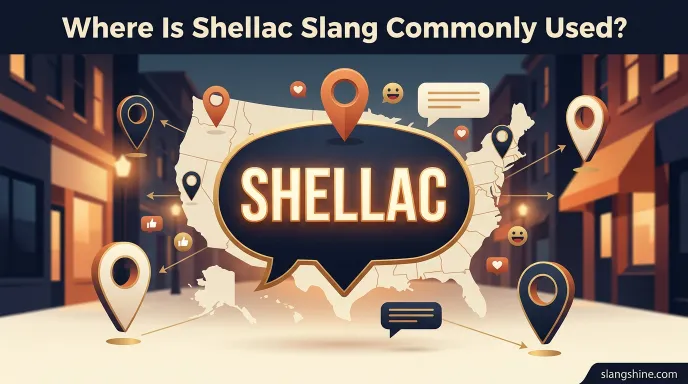
The slang sense of shellac is especially associated with U.S. and North American informal English.
Oxford labels the verb sense informal North American English, while Collins describes the defeat sense as slang, mainly associated with American and Canadian usage.
You are most likely to encounter it in contexts where informal language is common, such as:
- American sports coverage
- Casual conversations
- Gaming communities
- Social media
- Online discussions
- Text messages
- Informal commentary
It is less common in formal business writing or academic English.
If you encounter shellac in British English, context is especially important because the literal meaning is still widely understood, while the slang sense has stronger North American associations.
Shellac vs. Shellacked vs. Shellacking
These three forms are closely related, but they are used differently.
| Word | Meaning | Example |
| Shellac | To defeat someone badly | “They shellac their opponents.” |
| Shellacked | Was defeated badly | “They got shellacked.” |
| Shellacking | A severe or one-sided defeat | “The team suffered a shellacking.” |
Shellac is the verb.
Shellacked is commonly used as the past tense or adjective-like form.
Shellacking is the noun describing the severe defeat itself.
For example:
“They shellacked us.”
This means they defeated us badly.
“We got shellacked.”
This means we were badly defeated.
“It was a complete shellacking.”
This means it was a severe or one-sided defeat.
Merriam-Webster defines shellacking as “a lopsided defeat,” and Collins similarly gives the word the sense of a thorough defeat or beating.
The distinction is useful when answering searches such as “Why is it called shellacking?” because “shellacking” is not simply another spelling of “shellac.” It is the noun form describing the result or experience of being badly defeated.
Why Is It Called Shellacking?
The phrase “shellacking” is unusual because the literal word “shellac” refers to a type of resin and coating, while the slang form refers to a severe defeat.
The exact origin of the slang meaning is not completely certain. Historical evidence points to several possible influences, and it would be inaccurate to present one explanation as proven fact.
One important explanation connects the idea of shellacking with the physical process of applying shellac. Shellac was traditionally applied as a finish, often involving repeated brushing.
Some explanations suggest that this physical action may have helped inspire the figurative idea of giving someone a thorough beating.
Another possibility comes from an older slang use of shellacked meaning “drunk.” Historical sources show that this meaning was already in use in the early 1920s.
From there, the word may have developed or influenced later figurative uses involving being badly beaten or overwhelmed.
What is clearer is that shellacking was being used for severe defeat or beating by the 1920s, particularly in American sports and boxing contexts.
Historical examples discussed in the English Stack Exchange research include 1920s boxing reports and a 1923 football article using “shellacking” for a heavy defeat.
So, when asking “Why is it called shellacking?”, the safest answer is that the slang developed in early 20th-century American English, but its exact path from the literal word to the modern meaning remains uncertain.
When Did Shellac Start Meaning “Defeat”?
The slang meaning of shellac as “to defeat badly” appears to have emerged in the early 20th century.
Merriam-Webster gives the verb’s literal use of “coat or treat with shellac” a first known use of 1876, while historical slang evidence places the “defeat” sense around the 1920s. Etymonline also records the slang sense “beat soundly” by around 1930.
The word shellacking has its own dictionary history. Merriam-Webster gives its first known use as 1931 and defines it as a lopsided defeat.
Historical newspaper examples are especially useful because they show that the expression was not simply a modern internet invention.
It was already appearing in American sports writing decades before texting, social media, or online gaming existed.
This history also explains why the word can sound especially natural when describing a dramatic sporting result.
Its early popular use was strongly connected with beating and one-sided competition.
Did “Shellacked” Ever Mean “Drunk”?
Yes. “Shellacked” had an older slang meaning associated with being very drunk.
This historical meaning is important because it is sometimes overlooked when explaining the word’s history.
According to historical discussion cited in the English Stack Exchange research, “shellacked” was being used in the early 1920s to mean extremely intoxicated.
Etymonline also records “shellacked” in the sense of drunk in Dialect Notes in 1922.
For example, an old speaker could use “shellacked” to describe someone who had consumed a large amount of alcohol.
That does not mean that modern speakers normally use “shellacked” to mean drunk.
Today, if someone says:
“Our team got shellacked.”
They almost certainly mean the team was badly defeated, not that the players were drunk.
The older alcohol-related sense is mainly useful when discussing the history and development of the slang, not as a common modern definition.
Because the historical connection is not fully settled, it is better to describe the drunk meaning as an earlier documented sense that may have influenced the word’s development, rather than claiming that it definitely evolved directly into the modern defeat meaning.
Shellac vs. Similar Slang Words
Several informal words can describe a heavy defeat, but their tone and common usage differ.
| Word | Basic meaning | Typical tone |
| Shellac | Defeat badly | Informal, sometimes humorous |
| Shellacked | Defeated badly | Informal |
| Shellacking | A severe defeat | Informal |
| Clobber | Beat or defeat decisively | Casual |
| Thrash | Beat someone thoroughly | Informal |
| Trounce | Defeat decisively | Informal/standard |
| Crush | Defeat overwhelmingly | Very common |
| Demolish | Defeat overwhelmingly | Figurative, strong |
For example:
“The Lakers crushed their opponents.”
And:
“The Lakers shellacked their opponents.”
Both suggest a decisive win, but shellacked has a more colorful and informal feel.
Similarly, trounce is a standard English verb that can work in more contexts, while shellac has a distinctly informal American flavor.
The best synonym therefore depends on the tone you want. If you are writing a formal report, defeated decisively is safer.
If you are writing a casual sports post, shellacked can sound more lively.
When Should You Avoid Using Shellac?
Although shellac is not normally offensive, it is still an informal expression.
Avoid it when writing something that requires precise or formal language, such as:
- Academic papers
- Formal business reports
- Official announcements
- Legal documents
- Professional research
- Formal news copy where a neutral expression is preferred
Instead of:
“The company shellacked its competitor.”
A formal version could be:
“The company significantly outperformed its competitor.”
Likewise, instead of:
“The team got shellacked.”
A neutral sports report might say:
“The team suffered a heavy defeat.”
In casual communication, however, there is usually no problem with using shellac.
What Does Shellac Mean in Slang on Social Media?
On social media, shellac usually keeps the same basic meaning: to defeat someone badly.
The context may be sports, gaming, arguments, competitions, or even humorous comparisons.
For example:
“That player got shellacked in the final 😭”
The sentence suggests a very one-sided loss.
A social media user might also write:
“My team absolutely shellacked them.”
Here, the speaker is emphasizing the strength of the team’s victory.
The word does not have a special TikTok-only, Snapchat-only, or Reddit-only definition. Unlike many internet abbreviations, shellac is an established English word whose informal meaning existed long before social media.
That is an important distinction when answering searches such as “shellac slang in English.”
Shellac Pronunciation
The pronunciation of shellac can vary slightly by dictionary and accent.
Oxford Advanced Learner’s Dictionary gives pronunciations including /ʃəˈlæk/ and /ˈʃelæk/.
A simple approximation for English learners is:
shuh-LACK
The second syllable is usually the stronger one in the common pronunciation.
For shellacking, the pronunciation follows the same basic beginning:
shuh-LACK-ing
Knowing the pronunciation can be helpful because the spelling may initially make the word look unfamiliar, especially when someone hears it in sports commentary rather than reading it.
FAQs About Shellac Slang
Q1. What does shellac mean in slang?
Answer. In slang, shellac means to defeat or beat someone very badly. It is commonly used for a decisive or one-sided victory, especially in sports and other informal competitions.
Q2. What does it mean to shellac someone?
Answer. To shellac someone means to defeat them decisively or overwhelm them in a competition. For example, “They shellacked us” means “They beat us badly.”
Q3. Is shellac slang rude?
Answer. No, shellac is generally not considered rude or offensive. It is an informal expression, although telling someone they were “shellacked” can sound teasing or mocking depending on the situation.
Q4. What is the shellac slang full form?
Answer. Shellac has no slang full form because it is not an acronym. It is an ordinary English word that developed an informal meaning related to severe defeat.
Q5. Why is it called shellacking?
Answer. The exact origin of “shellacking” is uncertain. Historical evidence shows the term was used in American English for severe beating or defeat by the 1920s, with several possible explanations for how the figurative sense developed.
Q6. Did shellacked ever mean drunk?
Answer. Yes. “Shellacked” was documented as slang for being drunk in the early 1920s. That is an older historical meaning and should not be confused with the modern sense of being badly defeated.
Conclusion
The shellac slang meaning is straightforward once you know the context: to shellac someone means to defeat, beat, or overwhelm them badly. The related noun shellacking describes the severe or one-sided defeat itself.
The word is especially useful in informal American English, including sports, gaming, social conversations, and online discussions. It is not an acronym, and it is not normally offensive.
At the same time, shellac has a completely separate literal meaning connected with a resinous coating. Its slang history is more complicated.
Historical evidence shows an older “shellacked” meaning related to drunkenness and later examples of “shellacking” for severe beating or defeat. However, the exact route connecting these meanings is still uncertain.
So if someone says, “They got shellacked,” the modern meaning is usually simple: they got beaten badly.
Learn More Slang Terms:
- Mug Slang Meaning: What Does “Mug” Mean in Slang in 2026?
- Pickleball Slang: Kitchen, Dink, Banger & More Explained (2026)
- Feen Meaning Slang: What Does “Feen” Mean Online?

Hi, I’m Anna Whitmore. I have 7+ years of experience writing about English slang and vocabulary. At SlangShine, I create simple, easy-to-understand content for English learners.