What does dis mean in text? “Dis” usually means “this” in informal texting and online conversations. People use it in messages, memes, and social media comments. In some contexts, it can also refer to disrespect or the slang word “diss.”
For example, someone might write, “Dis is so funny,” instead of “This is so funny.” However, if someone says, “Why did you dis me?” they may mean that you disrespected or insulted them.
Understanding what does dis mean in text depends on the context and surrounding words. This guide covers its common meanings, texting examples, and suitable replies.
Dis Meaning in Text
In texting, “dis” often means “this.” It is an informal spelling that reflects how some people pronounce the word in casual speech. If you’re wondering what does dis mean in text, you may see it when someone wants their message to sound relaxed, playful, or conversational.
For example:
- “Dis is my favorite song.” This is my favorite song.
- “Look at dis picture.” Look at this picture.
- “Dis movie is amazing.” This movie is amazing.
- “I can’t believe dis happened.” I can’t believe this happened.
In these examples, the meaning stays the same. Only the spelling changes. People may use “dis” in casual conversations, humorous posts, memes, and comments. It is not generally considered a standard spelling for formal English, so “this” is the better choice in school assignments, professional emails, and other formal writing.
Is Dis Slang or an Abbreviation?
“Dis” is usually an informal spelling, not an acronym. It does not stand for a phrase made from separate words.
Unlike IDK, which means “I don’t know,” or BRB, which means “be right back,” “dis” is often a written version of how someone says “this.”
The word can also appear in expressions connected with disrespect. For instance, “Don’t dis me” means “Don’t disrespect me.” In that sentence, the intended meaning is different from the usual “this” interpretation.
Therefore, look at the whole sentence before deciding what the sender means.
What Does Dis Mean in Everyday Chat?
The most common interpretation depends on how the word is used.
When it means “this”:
- “Dis looks good.” This looks good.
- “I need dis right now.” I need this right now.
- “Who sent dis?” Who sent this?
When it relates to disrespect:
- “Don’t dis my friend.” Don’t disrespect or insult my friend.
- “He tried to dis me.” He tried to insult me.
- “Why are you dissing her?” Why are you disrespecting her?
The first group refers to a person, object, idea, or situation. The second group describes insulting or disrespectful behavior. The surrounding words are the easiest way to tell these meanings apart.
Where Do People Use Dis?
The word can appear across many online platforms. Its meaning usually depends on if the conversation is about something being shown or discussed, or if someone is talking about an insult.
Dis on TikTok
On TikTok, “dis” may appear in video captions, comments, memes, or casual conversations. A creator might write, “Dis is exactly what happened to me,” when describing a relatable experience. In this example, “dis” simply means “this.” The spelling gives the caption an informal tone.
The word can also appear in videos about arguments, online drama, or criticism. In that context, a phrase such as “He tried to dis her” means that someone tried to insult or disrespect another person.
For example:
Comment: “Dis video has me laughing so hard.”
Meaning: The commenter is saying that the video is very funny.
Always consider the complete sentence. TikTok users discuss many different topics, so the spelling alone does not establish the intended meaning.
Dis on Snapchat
On Snapchat, people may use “dis” in direct messages, captions, or conversations with friends. It can make a message sound casual and similar to everyday speech.
For example:
A: What do you think of dis outfit?
B: It looks great on you!
Here, “dis” means “this.” The sender is asking for an opinion about an outfit. However, if someone writes, “Why did you dis me in front of everyone?” the meaning changes. They are asking why the other person insulted or disrespected them. Because Snapchat conversations are often brief, reading the complete message can help prevent misunderstandings.
Dis on Instagram
On Instagram, “dis” may appear in Reels comments, captions, memes, and direct messages. People sometimes use informal spellings to make their comments feel more conversational. For example, someone might comment, “Dis is too relatable,” under a video about everyday problems. They mean that the video reflects an experience they recognize.
In other situations, “dis” may relate to online criticism. A comment such as “That was a dis” can describe an insult or a disrespectful remark. The tone also matters. A playful comment between friends may not be intended as a serious insult, while a hostile comment may be genuinely hurtful.
Dis on WhatsApp
WhatsApp users may write “dis” when chatting with friends, sharing pictures, or talking in group conversations.
For example:
A: Can you send me dis photo?
B: Sure, I’ll send it now.
The first person is asking for a particular photo. Here, “dis” means “this.” The same spelling can appear in conversations about disagreements. If someone says, “He keeps trying to dis me,” they mean that the person keeps trying to insult them.
When chatting with family members, colleagues, or people who prefer standard English, writing “this” may be clearer. It avoids confusion for readers who are unfamiliar with the slang spelling.
Dis in SMS Text Messages
Traditional SMS messages can contain informal language just like social media chats. Someone may write “Dis is important” when texting a friend or “Who told you dis?” when asking about a situation.
These sentences mean “This is important” and “Who told you this?” However, “dis” is not a universal texting abbreviation. Some people use it regularly, while others always write “this.”
If you receive a message such as “Don’t dis me,” do not automatically interpret it as “Don’t do this to me.” In that sentence, the sender is more likely referring to disrespect.
What does Dis mean in text? 10 Real Chat Examples
These examples show how “dis” can appear in everyday conversations. Some use it to mean “this,” while others show the related meaning of disrespect.
Example 1: Talking About a Photo
A: What do you think of dis picture?
B: I love it! The lighting looks amazing.
A: Thanks, I took it yesterday.
Meaning: “Dis” means “this.” The sender is asking for an opinion about a picture.
Example 2: Sharing a Funny Video
A: Have you seen dis video?
B: Yes 😂 I watched it three times.
A: The ending is hilarious.
Meaning: The sender is asking if the other person has seen a particular video.
Example 3: Asking for Help
A: Can you explain dis question to me?
B: Sure, send me a picture of it.
A: Okay, give me a minute.
Meaning: “Dis” means “this.” The sender wants help with a specific question.
Example 4: Talking About Food
A: Dis pizza looks so good.
B: I know! We should order one.
A: Let’s get it for dinner.
Meaning: The sender is talking about a particular pizza and saying that it looks delicious.
Example 5: Reacting to a Surprise
A: Guess what happened today!
B: What? Tell me!
A: Dis was the best day of my life.
Meaning: “Dis” means “this.” The sender is describing the day as a wonderful experience.
Example 6: Discussing a Joke
A: Why are you laughing so much?
B: Look at dis meme 😭
A: Okay, that is actually funny.
Meaning: The sender is asking the other person to look at a particular meme.
Example 7: Asking About a Message
A: Who sent you dis?
B: Someone from my class.
A: Oh, I thought it was your cousin.
Meaning: “Dis” means “this.” The sender is asking who sent a particular item or message.
Example 8: Talking About Disrespect
A: Why are you upset with him?
B: He tried to dis me in front of everyone.
A: That’s not cool.
Meaning: Here, “dis” means to insult or disrespect someone. It does not mean “this.”
Example 9: Defending a Friend
A: Why did you say that about my friend?
B: I was just joking.
A: Don’t dis my friends like that.
Meaning: The speaker is telling the other person not to insult or disrespect their friends.
Example 10: Clarifying the Meaning
A: What does “dis” mean in this message?
B: It depends on the sentence.
A: It says, “Dis is my favorite song.”
B: Then it means “this.”
Meaning: The word is being explained according to its context.
How to Reply When Someone Says Dis
Your reply depends on what the person means. If they use “dis” as a casual spelling of “this,” respond to the subject of the message. If they use it to describe disrespect, your response should fit the situation.
Casual Replies
When someone uses “dis” to point out a picture, video, or idea, you can answer naturally.
- “Yeah, I see it.”
- “That looks great!”
- “I know what you mean.”
- “That’s actually interesting.”
- “Let me check it out.”
For example:
A: Look at dis picture!
B: That looks amazing!
There is no need to comment on the spelling unless the other person asks about it.
Funny Replies
If the conversation is lighthearted, you can use a playful response.
- “Okay, now I need to see it 😂”
- “Why is dis so funny? 😭”
- “You always find the funniest stuff.”
- “Send it to me right now!”
- “I was not ready for that 😂”
These replies work best when you understand what the person is sharing and the conversation is friendly.
Friendly Replies
If someone is sharing something important or asking for your opinion, a helpful answer is usually better than a joke.
- “Thanks for showing me.”
- “I really like it.”
- “That makes sense.”
- “I understand what you’re saying.”
- “Sure, I’ll take a look.”
These responses keep the conversation clear and friendly.
Replies When Dis Means Disrespect
If someone says they were disrespected, acknowledge their concern instead of treating the message as a joke.
For example:
A: He tried to dis me in front of everyone.
B: That’s not okay. What happened?
You can also say:
- “What did he say?”
- “I understand why you’re upset.”
- “You deserve to be treated respectfully.”
- “Maybe you should talk to him about it.”
If someone tells you not to disrespect them, listen to what they are saying. A calm response can help prevent an argument from becoming worse.
Is Dis Rude or Offensive?
“Dis” is not automatically rude or offensive. When it means “this,” it is usually just an informal spelling. However, when it refers to disrespect or an insult, its meaning can be negative.
When Dis Is Harmless
The word is generally harmless when someone uses it to refer to an object, video, idea, or situation.
For example:
- “Dis song is amazing.”
- “Look at dis picture.”
- “I really need dis.”
These sentences use “dis” in place of “this.” The spelling may be informal, but the messages are not insulting.
When Dis Can Be Offensive
When “dis” means to insult or disrespect someone, the situation is different. For example, “Stop trying to dis me” means “Stop trying to insult me.” The speaker may feel that someone is making fun of them, criticizing them unfairly, or treating them disrespectfully.
If a comment is genuinely offensive depends on the words, tone, relationship, and situation. A joke between close friends may be received differently from an insult directed at someone in public.
Is Dis Appropriate at School or Work?
If you are using “dis” to mean “this,” the main concern is formality rather than offensiveness. In a casual chat with classmates, friends, or coworkers, people may understand the spelling. In an assignment, professional email, or formal report, use the standard spelling “this.”
When “dis” means disrespect, avoid using it to insult classmates or colleagues. If you need to discuss a disagreement, clear and respectful language is more helpful than name-calling.
Who Uses the Word Dis?
People from different age groups and online communities may encounter “dis.” Its use depends on personal writing habits, regional speech, and the kind of conversations a person has.
Do Gen Z Users Say Dis?
Some Gen Z users use informal spellings such as “dis” in messages, comments, and memes. These spellings can make writing resemble casual speech. However, the word is not exclusive to Gen Z.
People from other generations may also use it, particularly if they are familiar with informal English or the slang meaning of “disrespect.” It would be inaccurate to assume that everyone in one age group uses the same slang.
Do Teenagers and Adults Use Dis?
Both teenagers and adults may use or encounter the word. A teenager might write “Dis is so funny” in a group chat, while an adult might use “dis” when discussing a song, video, or online comment.
The context usually matters more than the sender’s age. The spelling may simply reflect an informal style rather than a special meaning. Because “dis” can also refer to disrespect, readers should consider the complete sentence before interpreting it.
How Common Is Dis Online?
The spelling appears in informal English, but there is no single reliable measure showing how frequently every online community uses it.
Some people may recognize “dis” immediately, while others may find it unfamiliar. The related word “diss,” meaning an insult or an act of disrespect, is also used in discussions of music, arguments, and online drama.
If you are unsure, check if the sentence is pointing to something or describing someone’s behavior. That distinction usually helps you understand the intended meaning.
Origin of the Word Dis
The spelling “dis” is associated with informal English and pronunciation based writing. It is often used to represent how some speakers pronounce “this” in casual speech.
However, it can also appear as a shortened spelling related to “disrespect.” The exact origin of every modern online use is difficult to establish, and the word should not be attributed to one social media platform without reliable evidence.
How Did Dis Become an Informal Spelling of This?
In casual speech, pronunciation can vary across dialects and communities. Some people represent those pronunciation differences in writing, especially in dialogue, lyrics, jokes, and informal messages.
Writing “dis” instead of “this” can create a particular voice or conversational tone. However, the spelling is not a standard replacement for “this” in formal English.
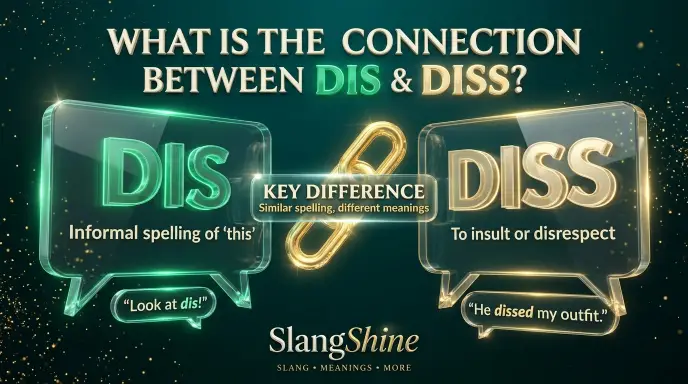
What Is the Connection Between Dis and Diss?
The word “diss” is commonly used as a verb or noun related to disrespect or insult. For example, “She dissed his idea” means she criticized or insulted his idea. “That was a diss” means the remark was an insult or a show of disrespect.
Although “dis” and “diss” are sometimes used interchangeably in informal writing, “diss” is the clearer standard spelling for an insult or act of disrespect. The meaning of “dis” as “this” is different. Always use the sentence to decide which interpretation makes sense.
Dis vs. This, Diss, IDK, IDC, and BRB
These terms may appear in online conversations, but they serve different purposes. Understanding their differences can help you interpret messages correctly.
| Term | Meaning | Type | Usage | Popularity |
| Dis | Often means “this”; can also relate to disrespect | Informal spelling / slang | Casual messages and online comments | Context-dependent |
| This | Refers to a person, thing, or idea | Standard English word | Everyday and formal writing | Widely used |
| Diss | To insult or disrespect someone; also an insult | Slang word | Arguments, criticism, and music | Established slang |
| IDK | I don’t know | Initialism | Expressing uncertainty | Widely recognized |
| IDC | I don’t care | Initialism | Expressing indifference | Widely recognized |
| BRB | Be right back | Initialism | Temporarily leaving a conversation | Widely recognized |
What Is the Difference Between Dis and This?
The main difference is spelling and style. When “dis” means “this,” the two words communicate the same basic idea.
For example:
- “Dis is my book.”
- “This is my book.”
Both sentences identify the book. The second sentence uses standard spelling and is suitable for formal writing.
What Is the Difference Between Dis and Diss?
“Dis” can mean “this,” depending on context. “Diss” usually refers to an insult or an act of disrespect.
Compare these sentences:
- “Look at dis.” Look at this.
- “Don’t diss me.” Don’t disrespect me.
The second sentence uses “diss” as a verb. Remembering this distinction can prevent confusion when reading messages about arguments or online drama.
Real-World Example of Dis in Use
Imagine that a friend sends you a photo of a new pair of shoes on WhatsApp and writes, “Dis is the pair I want to buy.”
You understand that your friend is talking about the shoes in the picture. You might reply, “They look great!” In this case, “dis” simply means “this,” and the conversation is friendly. Now imagine a different situation. A friend tells you, “He tried to dis me in front of the whole class.”
This time, the friend is describing an insult or disrespectful comment. They are not pointing to an object or asking you to look at something. The spelling is similar, but the meanings differ because the sentences use the word differently.
The best way to understand “dis” is to read the entire message rather than interpreting the word by itself. If the sentence is still unclear, asking the sender what they mean is a simple way to avoid misunderstanding.
FAQs About What does Dis mean in text
Q1. What Does Dis Mean in Text Messages?
Answer: “Dis” usually means “this” in informal text messages. However, it can also relate to disrespect, depending on the sentence.
Q2. What Does Dis Mean on TikTok?
Answer: On TikTok, “dis” often means “this” in captions and comments. In conversations about insults or online drama, it may refer to disrespect.
Q3. Is Dis Slang?
Answer: Yes, “dis” is an informal spelling often used in casual messages. It is not a standard acronym like IDK or BRB.
Q4. Is Dis Rude or Offensive?
Answer: Not usually. When “dis” means “this,” it is generally harmless. When it refers to insulting or disrespecting someone, it can have a negative meaning.
Q5. How Should You Reply to Dis?
Answer: If someone uses “dis” to mean “this,” respond to what they are discussing. If they are talking about disrespect, ask what happened or respond calmly.
Q6. What Does Don’t Dis Me Mean?
Answer: “Don’t dis me” means “Don’t disrespect me” or “Don’t insult me.” The speaker may feel that someone is making fun of them or treating them unfairly.
Q7. What Is the Difference Between Dis and Diss?
Answer: “Dis” often means “this,” while “diss” usually means to insult or disrespect someone. Context helps distinguish the two.
Conclusion
In text messages, “dis” usually means “this” and is an informal spelling used in casual conversations, memes, and social media comments. If you wonder what does dis mean in text, it can also relate to disrespect, especially in phrases such as “Don’t dis me.”
You may encounter the word on TikTok, Snapchat, Instagram, WhatsApp, and other online platforms. To understand its meaning, look at the complete sentence and the situation in which it appears.
Use “this” in formal writing, and use respectful language when discussing disagreements. Understanding what does dis mean in text also means recognizing the difference between “dis” as an informal spelling of “this” and “diss,” which refers to disrespect or an insult.
Learn More About Slang:
- What Does DIDO Mean in Text? Meaning and Examples
- What Does Diff Mean in Text? Real Meaning, And Examples
- What Does Dip Mean in Text? Real Meaning, & Social Media Use

Hi, I’m Emma Carter, an English language writer with over 8 years of experience in vocabulary and language learning. At SlangShine, I write simple, accurate, and easy-to-understand articles about slang, synonyms, idioms, and everyday English to help learners build confidence and improve their communication skills.